
Filmic dialogues
A Literature Review PRelude
Though this research is grounded in the sonic and various spatial stagings, it is imperative to preface the supporting practice with the rationale behind the inclusion of its filmic counterparts. The ephemeral nature of sonic, spatial and performative practices necessitates tools of documentation in order to exist outside of their assigned temporalities, therefore this thesis’ supporting practice utilises film as an essential recording and re-staging device. Filmic dialogues is an extension of this thesis’ literature review, applying additional interrogation to artworks which specifically utilise film in ways which mimic the conditions of the sonic. These works employ a holistic view on public presentation that considers the visual mechanics of process to be vital component of spatial sonic and filmic experience.
As with the chosen practice-as-research methodology the introduction of film in sonic installation and as a primary experimental research method, makes reference to the modus operandi of Rosa Barba and the idiosyncrasies of On the Anarchic Organisation of Cinematic Spaces (2022). Firstly in Barba’s detailed application of spatial understanding, both from the point of view of staging a representation of one space within another and secondly, in the scope of the dissemination of cinema as a whole and its constructed spatial expansion. The very basis of Barba’s work is investigative and the point of enquiry is its own structure and the functions of its materiality. These functions, are then catalogued in new ordering systems. Barba uses these arrangements to aid in the classification of what the world is presenting, by dismembering and reconfiguring material to generate densely layered structures which engage with a ‘space beyond cinema and comprise a futuristic vision of its conditions’ (Barba, 2022, Pg 7).
A key concept referenced throughout this thesis in relation to the sonic rather than the filmic, is the fact that Barba values the dualistic properties of moving image, which hold the simultaneous capacities of being both ‘an immaterial medium [which] carries information’ whilst also acting as a ‘physical material with sculptural properties’ (Barba, 2022, Pg 7). These qualities allow the components of Barba’s filmic installation to expand and abstract beyond the physical matter of the celluloid strip, the projector through which it passes and even the thrown image, recognising that it is instead the ‘landscape [of integrants] itself which forms the screen’ (Barba, 2022 Pg 8). Akin to Barba’s approach, the supporting practice for this thesis acts as a point of departure which dilates sonic concepts whilst traversing its intrinsic properties. Installations of both sonic and filmic art are partnered in their intention of establishing duration. This acknowledges a seminal shift from time based qualities of music and performance, to the spatial and sculptural potentialities of sound and moving image that are locked into the construction and politics of a gallery setting. This entrapment of media enforces an acknowledgment of temporality, which permits the audience to set the pace at which they experience the installation.
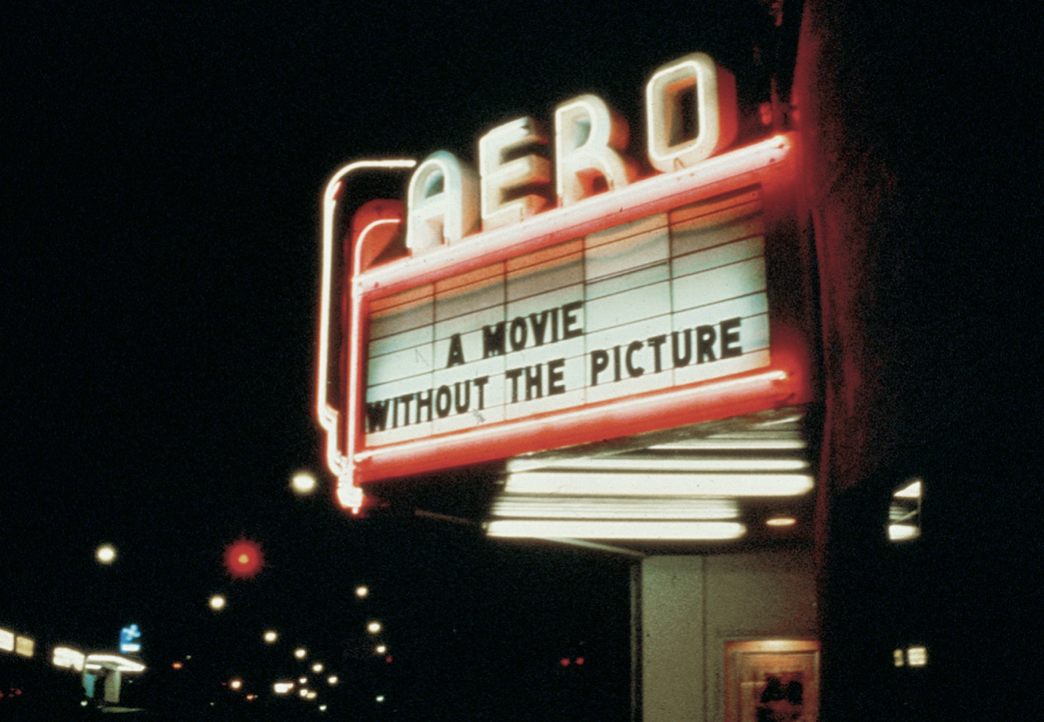
The tension between the roles of the sonic, visual and their settings has been long explored throughout the history of experimental film making. Which sought to marry sound and image for both ‘commercial and synaesthetic reasons’ (Cox, 2018, Pg 196) whilst simultaneously unsettling the conventions of the format. There is something wholly ‘anarchic’ about the broken assemblage of the forms, which is exemplified in the work of artist Louise Lawler. A Movie Will Be Shown Without The Picture (1979) (Figure 1) follows the very instruction of the title, presenting a popular Hollywood film in a conventional cinema setting that is devoid of the image track. Lawler constructs a space of audience expectation, in which the environment itself probes their existing knowledge of the attributes of such sites and subverts assumed proceedings, drawing attention to the blackened screen, void of content and the information-dense soundtrack. Through this action Lawler unsettles and questions the marriage of sound and image in what is referred to as cinematic parlance, challenging the ritualised experience of a trip to the cinema, as it is stripped of one of its most crucial components. This forces the audience to attune to their sense of sound and the sonic triggers provided.
The selected film varies each time the action is performed, which may result in an audience member having previously watched the chosen motion picture. In this case the crowd may not question the materialisation of the medium, but instead charge the emptiness with remembered images. This suggests that Lawler’s purpose, or that of any sonic installation, is not simply to focus one’s attention on their listening, the physicality of the presented sonic matter or semantic understanding of such sounds; it instead places an emphasis on the active role the audience is granted when their reliance on visual accompaniment is challenged.
‘There is no such thing as empty space’(Cage, 1967, Pg 8), for as long as a 'human eye is looking’ or the ear is listening, there will always be something to see or hear. To look into the empty void of the cinema screen, is still to be looking, ‘still to be seeing something, if [that is] only the ghosts of one’s own expectations’ (Nancy, 2005, Pg 4). This plays into the aforementioned concept and supporting methodologies of recordari the Latin for remember or to call to mind; giving prominence to one’s perception of site and listening, utilising sonic triggers to unlock stored intangible versions of places and faces of the past.
The potentialities of cinema as a form of sonic art are defined by theorist Christoph Cox throughout Sonic Flux (2018), presented via an exploration of sound in relation to metaphysics, meaning the first principles of things, including abstract concepts of being, knowing, identity, time, and space are elucidated. Cox recognises the interwoven properties of sound and film, specifically through the comparative methods of field recording and cinematic archival process. These formats tap into a ‘documentary impulse’ which applies found material and transposes it towards more ‘aesthetic or compositional ends’ (Cox, 2018, Pg 204). Though the media structures hold a compatibility, the classic opposing poles which emerged as a result of the manifestation of musique concrète, persist. On the one hand, the pairing of the audio and visual, exists in the ‘referentiality and site-specificity of recorded sound [or image]’, and on the other, dwells within ‘the detachability of sound from source and site’ which enables ‘an engagement with sonic matter itself’ (Cox, 2018, Pg 204).
The practice supporting this thesis sits between the two conclusions proposed by Pierre Schaeffer, as the installation of such works is restaged in multiple spaces and formats, which respect Schaeffer’s call for the acousmatic and reduced listening, in order to ‘bracket the circumstances of sonic production or order to attend to sonorous objects themselves’(Cox, 2018, Pg 205).
This then posits the consideration of film as a sound object, in all its heavily curated sensorial and spatial qualities, which consorts with the deliberations of sound as an experience, an event, or a relation. Sound Objects (Steintrager, 2018) pursues the questions of sound’s elusive objectivity, through the concepts of acousmatic listening and memory, though it is the contribution of theorist John Mowitt that brings the medium of cinema into the discussion.
The Sound of Arche-Cinema (2018) probes the conceptual issues that forefront contemporary sonic conversation and predicates the inclusion of film in these theories, by recognising that moving image is ‘more than an occasion for thought’ and does not act in the way of the Turing machine, in the scope of a convincing simulation of thinking, but it instead incites the ‘cognitive faculty of memory itself’ (Mowitt, in Streintrager, 2018, Pg 213). The ‘object-hood’ of the amalgamation of sound and image is achieved through their catchment sphere, situated in the bespoke theatre, akin to that of a cathedral, designed precisely for the experience that it delivers.
It is within these spaces that considerations of sound within and beyond its role in meaning, communication, and information emerge. These sensorial domains are built up of ‘things that have been heard about and subsequently turned to account’ combined with things that haven been ‘experienced, [seen by] the subject himself’ (Freud, 1896, Pg 197) .
Filmic dialogues are present throughout the majority of this thesis’ chapters and supporting practice, which correlate to thematic strands of sonic object-hood, spatial voicing and semantic understanding. The process of post-syncing sound to moving image highlights the importance of the harmonious tallying of the two in order to facilitate linguistic understanding and dimensional awareness; and when modifications in this method occur alternate symbolism arises. For example, if movements of the mouth on screen are not time matched to the corresponding audio, there is a disconnect between what is being seen and what is being said, establishing the role of a visual voice in semantic comprehension.
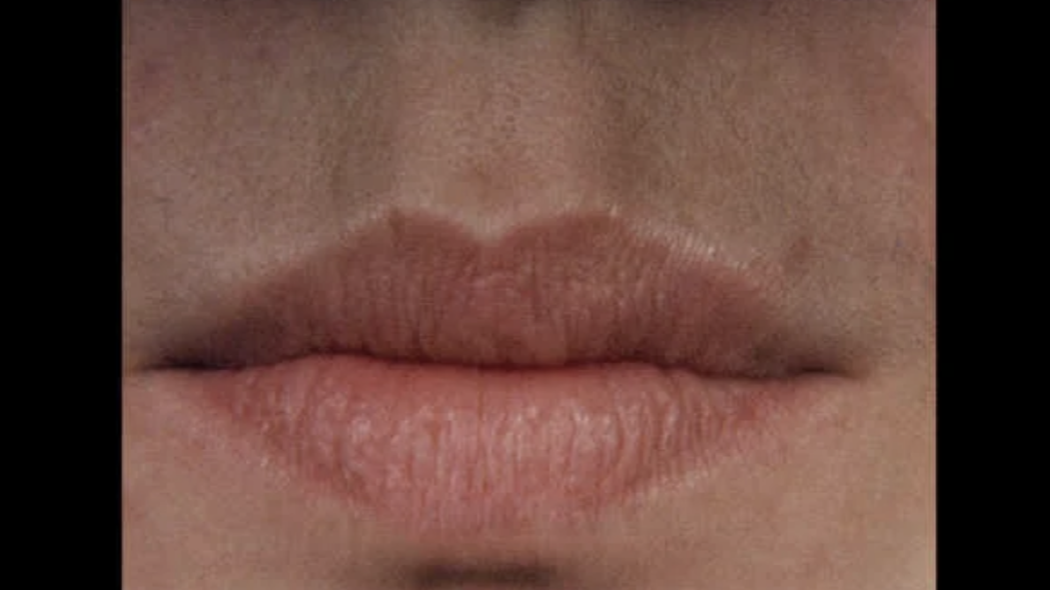
This catalysts a sonic flux, one which is exemplified in the experimental film making of Mike Dunford, specifically in SYNC.SND (1974) (Figure 2). An offscreen voice delivers a series of questions regarding the history of early sound-cinema, to an on-screen close-up of a pair of lips responding, initially, in-sync. After a brief interval of darkness, the mouth reappears, though this time the audio is slightly off-kilter. What was once an exercise in kinetic lip-reading in the quest for information becomes a superseding ‘desire for sync sound’ (Cox, 2018, Pg 196) as the viewer pines for the ‘consummating moments when sound and image coincide’ (Cox, 2018, Pg 196). The focus is now on the ‘materiality of vocal articulation’ and without the correct corresponding soundbites the mouth and its movements, ‘become strange, fleshy and viscous’ (Cox, 2018, Pg 196). This disruption to the natural association of simultaneous sound and image pairings, reveals the power that the sonic has in the stabilisation of definition and experience.
The act of image-capture directly to analogue film formats exposes the potential to compartmentalise sound, as sync-dialogue cannot be recorded via this medium, this allows the sonic world to be built in a fragmentary process. This operation favours the remembered corresponding sonic experience of the collected images, that are simulated in sound studios after the fact, replicated by unconventional objects and pieced together in orders which challenge the connotations of their visual accompaniments. The process of post-syncing to augment and expand spatial perception, is explored through the work Y BALA (2023) in Space Sounding. The work acknowledges that whilst sound-syncing generally applies to the moving image, the skewing of sound can be utilised as a tool in sonic-installation in gallery settings, whether these exhibitions include film or not.
John Akomfrah is primarily cited for the presentation of multi-layered film installation, though an equally vital, but lesser acknowledged component of his work, is that of the sonic. As with Barba, Akomfrah utilises filmic installation in gallery settings rather than for the world of cinema, in which sound plays a transformative and essential role, in both the artwork and one’s own experience of the world. Akomfrah’s work praises the sonic for its aid in the understanding of time and of oneself within it.
Early iterations of Akomfrah’s fragmented and dissonant sonic inclusion were deemed by critics to hold a vulgarity, however when unpacking the etymology of the critique it suggests characteristics of belonging to the ‘ordinary people’ derived from the latin vulgus. This kind of commonality speaks volumes in relation to the sonic, when it is overlapped and combined with a range of sounds, from multiple sources including musique concrète to opera, classical, and folk, the language is one of universality. Noise is utilised to propagate conversations and direct attention to images, suggesting that it is the role of sound to sculpt narrative and navigate space; solidified by Akomfrah’s equal in investment in sound and images alike. This thesis will continue to make reference to Akomfrah’s work as a case study for both practical and research models throughout its methodology and Chapter 1’s associated practice.
In light of the aforementioned artworks and theories, the supporting practice of LIDO (2022), Y BALA (2023), Albertine (2024) and By-Flete (2024) apply film as a speculative instrument, that aids in the interrogation of the qualities and remembrance of space. A sculptural approach to film and sound is employed throughout, which weaves relations between the work and the viewer. Perpetually transforming images by facilitating their translation through sound and spatial installation. This practice continues to be reflective of the methodologies of Barba, which regard cinema in an architectural sense,. Whereby the components of curated space, inclusive of the apparatus, screen, projection, speakers etc, are combined ‘to create another space beyond’ (Barba, 2022, Pg 8).
Figure 1
Louise Lawler
A Movie Will Be Shown Without the Picture (1979)
Aero Theatre, Santa Monica, California, December 7, 1979
Figure 2
Mike Dunford
SYNC.SND (1974)
Film Still
Duration: 6 mins, Ratio: 4:3, Original Format: 16mm film
1/Cinematic Parlance - refers to the visual and auditory techniques filmmakers use to convey a narrative, emotion, and meaning on screen. This includes camera angles, editing, sound design, mise-en-scène, and lighting.2/Musique Concrète - (French: “concrete music”),experimental musical composition technique using recorded sounds as raw material. Developed in 1948 by the French composer Pierre Schaeffer and his associates at the Studio d'Essai (“Experimental Studio”). 3/The Turing Machine - an abstract computational model that performs computations by reading and writing to an infinite tape.